I Dare You to Hold My Attention for Three Sentences

We spent years learning how to stop the scroll and almost no time learning how to deserve the next sentence.
Your brain gives bad news a head start.
Psychologists have been measuring this for decades. Negative information gets noticed faster, processed more thoroughly and remembered longer than positive information of the same size, and the pattern turns up so reliably that when Roy Baumeister and his colleagues reviewed the evidence in 2001, they titled the paper, with refreshing bluntness, “Bad Is Stronger Than Good.”
In 2023, a team of researchers tested what that means for the internet. They analysed more than 105,000 headline variations that Upworthy had run as live experiments, around 370 million impressions and 5.7 million clicks, and found that each additional negative word in an average-length headline raised the click-through rate by 2.3%. Each positive word cut it by about 1%. They called the paper “Negativity drives online news consumption,” which is about as plain as academic titles get.
So yes, it isn’t your imagination that the feed has learned to frown.
It’s getting busier too. In its second-quarter results this year, Meta reported delivering 14% more ad impressions than a year earlier, at an average price per ad that was 12% higher.
That’s more ads, each of them costing more, all aimed at the same thumb on the same phone at 11pm.
Under that kind of pressure, stopping someone mid-scroll starts to look like the entire job, and a lot of our industry has reorganised itself around it.
“Stop the scroll” turned into a brief, a course module and the title of roughly every webinar.
Which would be fine, if stopping people were still the hard part.
I keep seeing the same thing happen. A post opens with “This one mistake cost us $50,000” and I’m in, honestly, I want to know. Then come six lines of scene-setting, four motivational sentences about resilience, and a big reveal that the mistake was “not trusting the process.”
I would like my click back.
Advertising told us this in 1910
The odd thing is that… we were warned.
The formula most of us learned as AIDA is usually credited to an American advertising pioneer called E. St. Elmo Lewis, and in a talk he gave in 1910 he put it like this: “All advertising must attract attention, maintain interest, arouse desire, get action.”
The word I’d underline is maintain. The most famous formula in advertising treated attention as the easy opening move and spent the rest of its breath on keeping it.
Somewhere over the following century, we kept the A and lost interest in the rest.
Every hook borrows attention, and bad news borrows the most
A hook borrows attention, and the reader fully expects to be paid back.
The bigger the promise, the more you owe.
Tell me one mistake cost you $50,000 and you owe me the mistake, how it happened and why it got so expensive. Promise me an ad broke every rule and you owe me the rules, plus the reason it worked anyway.
And if you tell me nobody is talking about something, you’d better be very sure half of LinkedIn hasn’t made a carousel about it already.
Negative hooks borrow the most of all. The Upworthy numbers show they’re brilliant at earning the click, and my read is that they also put the reader slightly on guard.
Warn me about a mistake and I come in braced to be protected from something.
If the post then drifts into a pep talk, the whole thing curdles into a bait and switch, because I showed up ready for a threat and got handed a motivational quote.
This is why the copywriting formulas that use negativity well are built around paying it back.
PAS (problem, agitate, solution) is one of the workhorse formulas of direct response for exactly that reason. You name the problem, you make it sting a little more, and then you hand over the relief.
The negativity is a down payment on a solution, and the whole thing only works because the solution actually shows up. Drop the S, and you’ve written a horror story with a call to action.
What tends to happen instead is that a dramatic opening gets followed by more drama:
“I almost gave up.Then something happened.But there was a problem.Nobody saw it coming.Here’s what I learned.”
PLEASE. What happened?
Some posts are fifteen hooks standing on each other’s shoulders in a trench coat, and at some point the story has to actually start.
Curiosity needs edges
Open loops work because of a 1994 paper by the behavioural economist George Loewenstein, who described curiosity as an information gap. We get curious when we notice a space between what we know and what we’d like to know.
The word doing the heavy lifting is notice. The reader has to see the edges of the gap before they want to close it, and fifteen years later Loewenstein and a group of colleagues measured where those edges sit.
In a 2009 study, they asked people trivia questions, had them rate how confident they were in their guess, and found that curiosity peaked when people were about 50% sure of the answer.
When people had no idea, they didn’t much care, and when they were nearly certain they didn’t need to find out, so curiosity sat squarely in the middle. The same study found that people remembered the answers to questions they’d been curious about (and got wrong at first) noticeably better one to two weeks later, which, if you’re a marketer, is the kind of finding you underline twice.
Compare these two openings:
- This ad completely changed the game.
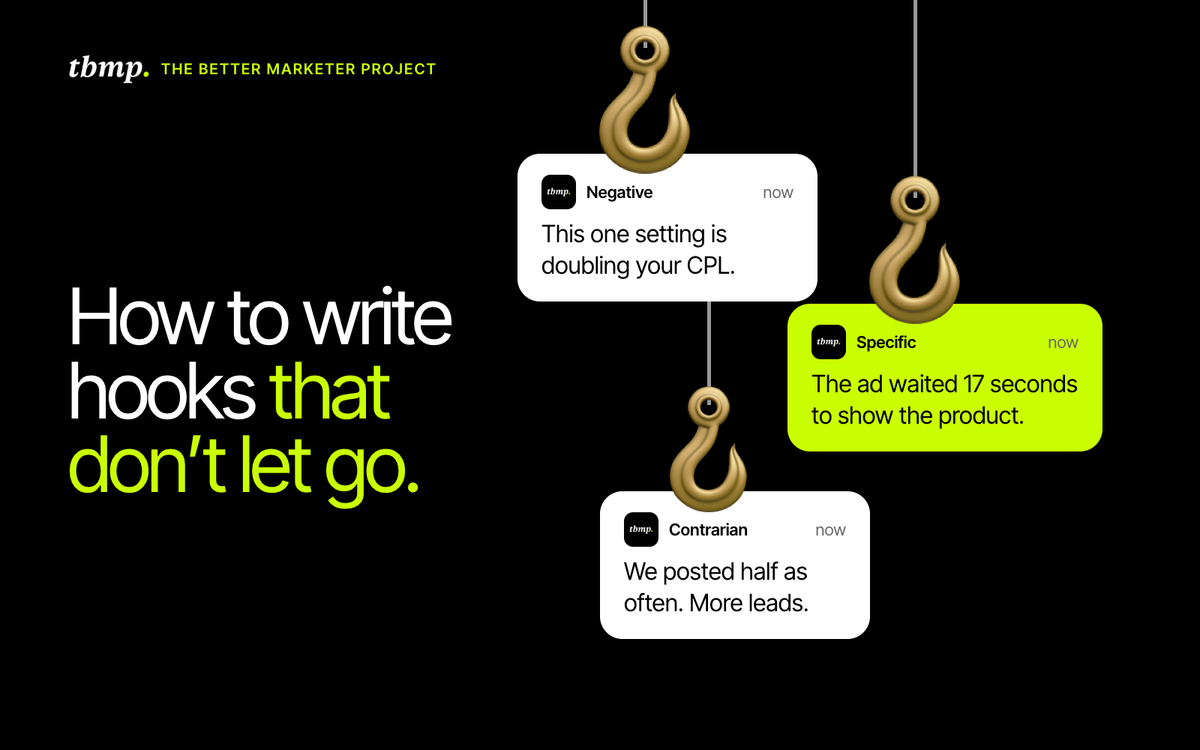
- The ad waited 17 seconds to show the product, and I watched the whole thing anyway.
The first one is loud and gives me nothing to hold, so I’m nowhere near that 50% sweet spot and I don’t much care. The second hands me a product, a strange decision and a result that shouldn’t make sense, which puts me right in the middle of the curve.
Now I genuinely want to know what happened in those 17 seconds.
Specific beats loud
“Stop the scroll” has convinced plenty of us that a hook needs to shout: a shocking number, a confession, a contrarian take, possibly the word “brutal.”
Negativity will get you a long way, and I’m not going to pretend the Upworthy data isn’t real. But some of the best openings barely raise their voice, they’re just too precise to ignore.
Every founder says they don’t have a voice until I ask what they disagree with.
There’s no manufactured emergency in that line and no promise that the next three minutes will transform your business. It works because it sounds observed. Somebody had to actually sit across from founders to notice it.
A formula can give an idea its shape, but the pulse has to come from somewhere real: the odd customer objection, the sentence someone said on a call, the test that failed, the metric that moved the wrong way, the small product detail everybody else walked past.
I wrote about this in the piece on Ogilvy’s electric clock, and it holds up here too. A number earns its place when the number matters, and plenty of great hooks don’t have one at all, but I can’t think of a great hook that wasn’t specific.
Sentence two is part of the hook
We give the first sentence a ridiculous amount of responsibility. It has to interrupt the pattern, spark curiosity, establish relevance, sound original and apparently change the course of someone’s life before they scroll another centimetre.
Meanwhile, sentence two sits there doing nothing, even though sentence two is where the reader decides whether your opening was substance or decoration.
Say a post opens with:
We cut our posting schedule in half and generated more qualified leads.
That’s a result I didn’t expect, so we’re off to a good start. Then the next line says:
In today’s fast-paced digital landscape, consistency is more important than ever.
GONE. Spiritually and physically.
A stronger second line moves toward the explanation:
Turns out the posts we cut were answering questions our marketing team found interesting, while the ones we kept answered questions buyers were already asking sales.
Now I know where the argument’s headed and I still want the details. Sentence two is the first repayment on the debt, and all it has to prove is that you’re good for the rest.
Proof is what keeps people reading
Writers tend to treat proof as something you bolt on later, once the fun opening is out of the way. I think proof is half of what keeps anyone reading, because every concrete detail buys you a little more attention: a screenshot, a real customer quote, the amount spent, how long it took, the exact button nobody clicked, the line the founder refused to sign off on because, in their words, “I would literally never say that.”
Details like these make an argument credible, and they also move the reader through it.
That’s why “show, don’t tell” is good advice right up until it becomes one more phrase people repeat without showing anything.
Don’t tell me the launch was chaotic. Tell me the team was still editing the pricing table eleven minutes before the announcement went live, and now I can actually see it.
The payoff has to match the promise
A hook can be technically true and still feel dishonest. You’ve seen this one:
“I made $100,000 from one LinkedIn post.”
Then, much later, you find out the writer had 300,000 followers, the money came from a year-long contract, and the post was simply where the eventual client first saw their name.
Did the post “make” $100,000? I suppose a lawyer could have fun with that sentence.
The real issue goes past exaggeration. The piece quietly rewrites the agreement after the reader has already clicked. A strong hook sets the terms honestly.
It can tease, it can hold the answer back, it can make the result sound exciting because maybe the result really is exciting.
When the reader reaches the end, though, they should think “that was worth knowing,” and never “oh, so that’s what you meant.”
The Hook Ledger: a framework for any business
Here’s the system, built on everything above. It works for a SaaS homepage, a skincare ad, a LinkedIn post or a cold email, because every one of those has the same job: borrow some attention, then pay it back.
Step 1: Work out what your reader already knows
In his 1966 book Breakthrough Advertising, the copywriter Eugene Schwartz laid out five stages of customer awareness, and sixty years on it’s still the most useful starting point I know, because the right hook depends entirely on where your reader is standing.
- Unaware: they don’t know they have the problem. Your hook has to be about them and their world, with your product nowhere in sight yet.
- Problem aware: they feel the pain but don’t know a fix exists. Name the pain more precisely than they could.
- Solution aware: they know fixes exist but haven’t heard of yours. Show what makes your approach different.
- Product aware: they know you and aren’t convinced yet. Lead with proof.
- Most aware: they’re nearly ready. Give them the offer and get out of the way.
A lot of hooks fail because they’re written for the wrong stage. Announcing your new feature to people who don’t know they have the problem yet is like giving a toast to an empty room.
Step 2: Write down the question
Write the exact question your reader will be holding after line one. If you can’t phrase it as an actual question, what you’ve written so far is an enthusiastic sentence.
Step 3: Pick your tension and check what it costs
The openings below are examples of each type, so swap in your own.
Negative and contrarian hooks make the biggest promises, so they cost the most to repay. Specific details and observations borrow less and are far easier to pay back, which is why they can carry a whole piece without strain.
Step 4: Make sentence two a repayment
Your second line should add context, evidence or a useful complication.
If it restates the hook, warms up, or reaches for a general truth about today’s fast-paced landscape, rewrite it.
Step 5: Check the debt is settled
Before you publish, read your ending and ask whether it delivered what the opening sold.
A teardown needs an actual teardown in it, a case study needs results, and a “how I did it” post has to get round to explaining how you did it at some point.
This sounds obvious, and the internet would like a word.
The template
Copy this and fill it in before you write a single line:
- Reader’s awareness stage: unaware / problem aware / solution aware / product aware / most aware
- The question they’ll be holding:
- Tension I’m using: negative / specific / contrarian / confession / observation
- Line one:
- Line two (first repayment):
- By the end, they’ll know:
If you can’t fill in the last line, don’t write the first one.
Go on, then
Your reader’s brain will give your hook a head start, especially if there’s a whiff of bad news in it, and with Meta serving 14% more ad impressions than a year ago, that head start is basically the price of entry. What happens after the first sentence is the part that’s actually yours.
So write the surprising first line. Make the uncomfortable claim, use the strange number, tell me the ad waited 17 seconds before showing the product. Then make the next sentence worth staying for, and the one after that, until scrolling away feels like walking out of a film ten minutes before the end.
I dare you.