5 Things You Can Steal From the John Lewis Christmas Ad (No Budget Required)

Here's an inconvenient fact for this year's John Lewis Christmas ad: the research says cash makes a pretty good gift. In a 2011 study, people appreciated receiving money more than the gifts they'd actually asked for, even though the givers assumed cash would be the least welcome option of all.
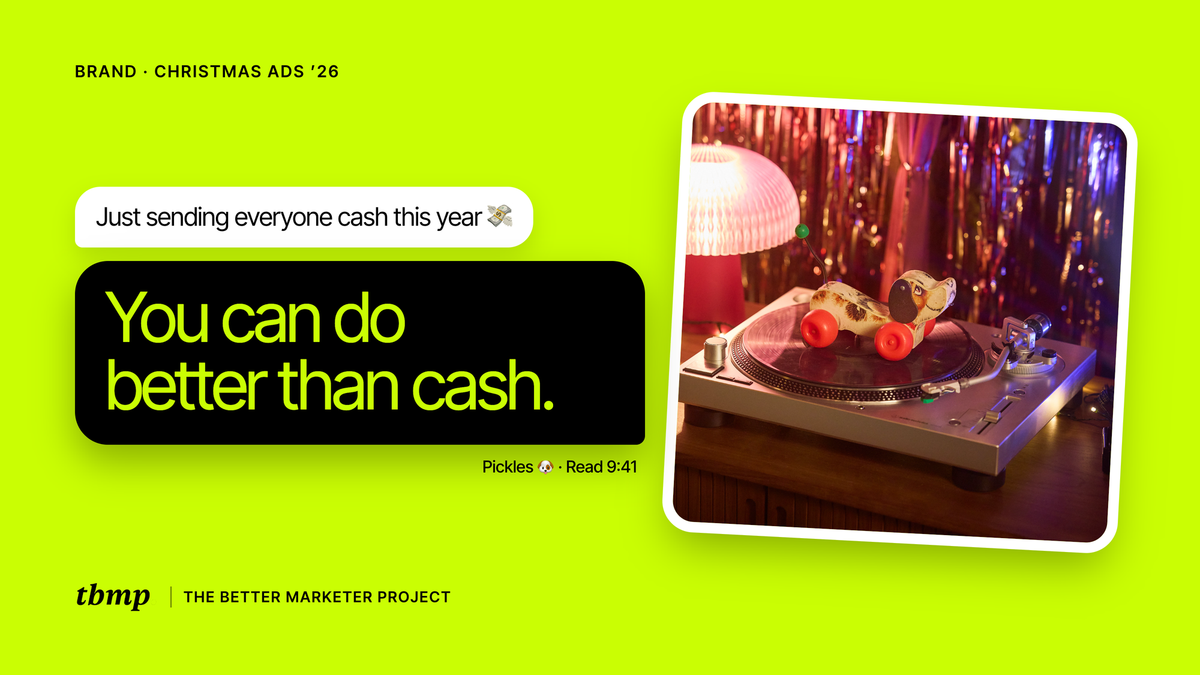
And yet John Lewis has just put extra budget behind its 20th Christmas ad, a three-minute film that very gently tells a grandmother not to give cash. It works anyway, and the reason it works is something any brand can borrow.
Here's the plot of the John Lewis Christmas advert 2026, released on Tuesday 3 November. Gloria (Dame Kristin Scott Thomas) isn't sure what her grandchildren want, so she settles on cash, until Pickles, her childhood toy dog (voiced by Paul Whitehouse), comes to life and tells her: "You can do better than cash." What follows is a last-minute gift hunt, a tuk-tuk ride through London and, on Christmas morning, a single key that opens her old home office, now a "Gran Cave" full of disco balls and fairy lights.
The soundtrack is Sam Fender covering the Rolling Stones' "You Can't Always Get What You Want," and the tagline is "Don't give up on giving."
It has a big budget, famous faces and a choir, and yet almost everything that makes it work can be copied by a brand with none of those things. Here are five.
1. Start with a worry your customer actually has
John Lewis didn't invent Gloria's problem. The retailer cited research finding that 52% of grandparents give cash because they aren't sure what young people want, and its marketing director, Rosie Hanley, summed up the insight like this:
"People want to give thoughtful gifts but can often lack confidence, so resort to giving cash."
That's the whole ad in one sentence, and it started life as a number. A worry like that does a lot of work in a campaign, because the viewer recognises themselves before they've seen a single product.
Panic, guilt, boredom and the nagging suspicion you're about to waste money all work the same way.
Steal it: write down the sentence your customer says to themselves right before they buy from you. Then look for proof it's real, like a review, a support email or the question that comes up on every sales call.
If you can attach a number to it, even better.
2. Sell to the person who's paying
Remember that study about cash from the top?
This is where the ad gets clever, because it never has to win that argument. It's talking to Gloria, and the grandchildren are simply the reason she's shopping.
A 2016 paper by researchers from Carnegie Mellon and Indiana University found that givers and receivers want different things. Givers focus on the moment of giving and want to wow the person in front of them, while receivers care more about how useful the gift turns out to be. John Lewis sells Gloria the moment: the key on Christmas morning and the children running into her arms.
The gift even turns out to be a room to spend time in, which the same researchers would approve of, since experiences tend to bring more enjoyment later on than material gifts do.
Steal it: ask who signs off on the purchase and who actually uses the product. In B2B, they're often different people, and so are a parent and a child, or a manager and their team.
Write one line about what each of them wants to feel, then decide whose feelings your campaign is really for.
3. Name the easy option, then offer a better one
Cash is the lazy default, and the ad says so out loud through a toy dog: "You can do better than cash." It's a gentle way of naming the competition, because at Christmas, John Lewis is up against the envelope in the card as much as any other shop.
Every brand has one of these. For accounting software it's the spreadsheet, for a personal trainer it's the free app, and for a lot of B2B tools it's doing nothing and hoping the problem goes away.
Naming it, kindly, tells the customer you understand the choice they're really making.
Steal it: finish this sentence: "If they don't buy from us, they'll probably just ___." Whatever goes in that blank is the competitor your next campaign should talk about.
4. Make the details human (and very specific)
The ad could have used any choir.
Instead, Fender re-recorded the children's vocals with pupils from his old school, John Spence Community High School, and arranged the brass with the Easington Colliery Band.
Even the toy is real: Pickles is based on a vintage pull-along dog, and a £12.99 Fisher-Price version is one of the products featured.
Details like these are why a big production still feels personal, and they're the cheapest part of any campaign. A precise detail persuades better than a big adjective almost every time, which is the same reason the hooks that hold attention are the specific ones.
The song is a detail too.
"You Can't Always Get What You Want" is the campaign's whole insight in a song title, so the music does the explaining while everyone else is busy getting emotional.
Steal it: pick one claim in your holiday campaign, like "thoughtful gifts" or "fast delivery," and swap it for the most specific true detail you can find.
5. Do it every year until people wait for it
This is John Lewis's 20th Christmas ad. The tradition started in 2007 with "Shadows," and since then it has given us The Bear and the Hare, Monty the Penguin and The Man on the Moon, to the point where people now look up the release date every November.
For the anniversary, Hanley said the retailer increased its spend and wanted to "push the boat out."
You don't need a three-minute film to build that kind of anticipation. You need something you do at the same time every year, in the same recognisable way, until people start expecting it.
Steal it: choose one thing you'll do every holiday season from now on, like a year-in-review email, an annual gift guide, a December sale with the same name or a handwritten thank-you to your best customers. Then put year two in the calendar.
Try it: the 10-minute holiday campaign
Copy this into your notes and fill it in before you brief anyone:
- The worry my customer has right before buying:
- Proof it's real (a review, an email, a number):
- The person paying, and what they want to feel:
- The easy option they'd choose instead of us:
- One specific detail only we could say:
- The thing we'll do again next year:
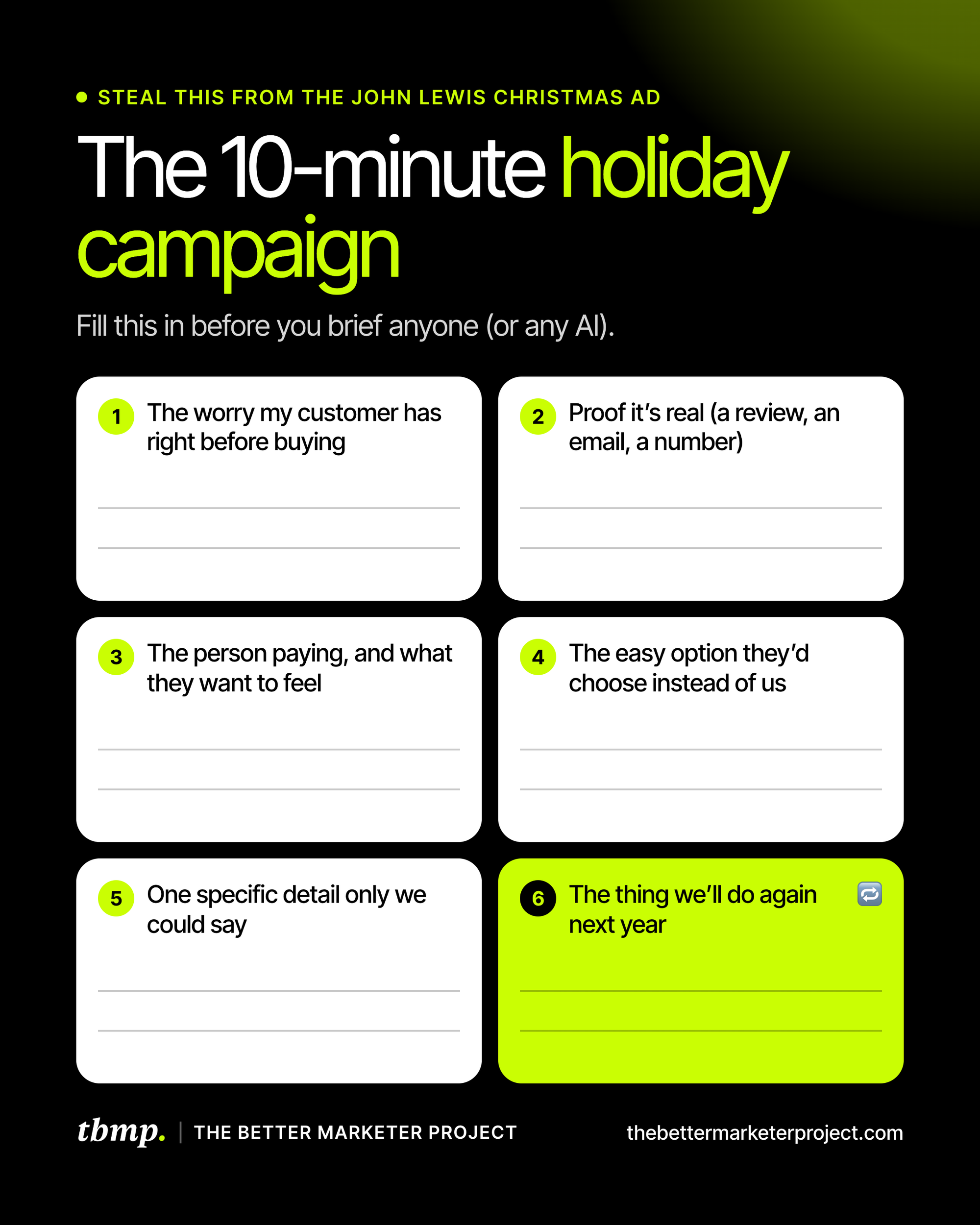
If you can fill in all six, you've got the bones of a holiday campaign, no tuk-tuk required.
John Lewis Christmas advert 2026
When was it released?
Tuesday 3 November 2026. The full three-minute version went out on social media that morning, and a 60-second cut premiered on TV that evening during ITV's Coronation Street and Channel 4's The Great British Bake Off.
What's the song?
Sam Fender's cover of the Rolling Stones' "You Can't Always Get What You Want," featuring a choir from his old school and the Easington Colliery Band. Proceeds from the record go to Action for Children.
Who's in it?
Dame Kristin Scott Thomas plays Gloria, and Paul Whitehouse voices Pickles the toy dog.
What's the tagline?
"Don't give up on giving."
Who made it?
Saatchi & Saatchi, directed by Lucy Forbes.
You can't always get what you want
The song has a point. But if you start with one honest sentence about what your customer is worried about, you'll get a lot closer than cash in a card.