The Thing Everyone Can Describe About Your Brand Might Be the Weakest Part of It

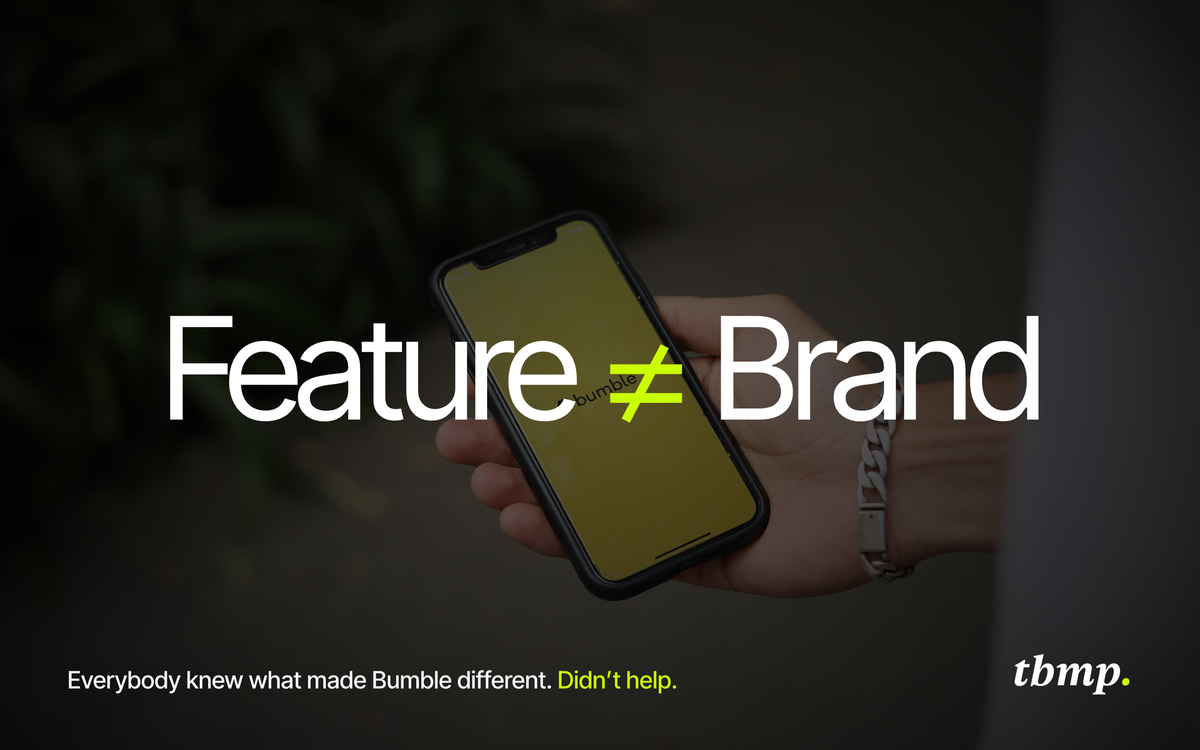
The thing everyone can describe about your brand might be the weakest part of it.
I have a question I ask clients that ruins the mood every time.
If I deleted the single most distinctive thing about your product tonight, the one feature people use when they explain you to somebody else, what would still be true about your brand on Thursday?
Nobody has a good answer ready. Not once, in nine years. They know what the product does differently. They have never had to say what they stand for once that difference is gone, because nobody ever made them pull the two apart.
Bumble is currently finding out in public.
The news, quickly, before the takes arrive
Bumble is in advanced talks to be taken private by Ithaca Holdings at roughly $1 billion. The Wall Street Journal broke it, Reuters confirmed through its own source, Bloomberg and the BBC followed.
Neither company has said anything, so this is talks, not a signed deal.
For context: Bumble was worth over $14 billion after its 2021 Nasdaq debut. Shares jumped about 50% on Monday to $3.80 when the story landed, which is a bleak sort of compliment. A stock that leaps 50% on “someone might buy us” was not carrying much hope to begin with.
By Thursday your feed will have settled on one explanation. Bumble built everything on women making the first move, Bumble scrapped the rule, Bumble is now being sold for parts.
Cause, effect, lesson, repost.
I went to check it, because that story is a little too satisfying, and satisfying is usually where I start looking.
The dates, which nobody is checking
Here is the actual order of events:
- February 2024 – Bumble cuts around 350 jobs as the sector hits what everyone’s calling a reckoning
- May 2024 – Bumble launches Opening Moves, letting women set a prompt in advance so men can reply first. The softening starts here, three months after the layoffs
- August 2024 – stock falls hard enough that Bank of America downgrades it
- 2025 – close to a third of the workforce cut. Whitney Wolfe Herd calls it an inflection point for online dating
- Full year 2025 – revenue down 10% to $965.7 million, net loss of $906.6 million, paying users down more than 11% to around 3.7 million
- Q2 2026 – paying users down another 16.4%
- 11 August 2026 – the women-first rule finally comes off
- 13 October 2026 – $1 billion takeover talks
Read that top to bottom. The rule everyone is blaming came off in AUGUST 2026, right at the bottom of a slide that started two and a half years earlier. The women-first requirement was switched on, in full, through every single quarter of the collapse.
So the causation runs the other way.
Bumble loosened its defining rule because it was losing, and kept loosening until there was nothing left to loosen. Wolfe Herd said the August change came from users asking for “more flexibility, less pressure,” which is a company reaching for the nearest lever while the numbers fall. Every company under pressure does this. It is not a strategy, it is a reflex.
So why didn’t the clearest brand in tech survive?
This is the bit I actually care about, and it is more uncomfortable than the version going around.
Ask anyone in 2019 what made Bumble different and they could tell you in three words.
Women message first.
Three words, instantly understood, impossible to confuse with anything else on the app store. Most brands never get within a mile of that.
It still wasn’t enough, which should bother you, because “be clearly differentiated” is the advice we all give.
Here’s my read on why.
Women-first lived inside the product. It was something the app made people do, which means it could be measured, tested, softened in May, removed in August. It sat at exactly the level where decisions get made by a growth team staring at a conversion dashboard at the end of a bad quarter.
What never got built underneath it was the thing that would have survived that decision. A belief about dating that stays true whether or not women message first.
If that existed, August would have been a feature change and nobody would have blinked. Without it, August just revealed that one product rule had been carrying the entire identity by itself for twelve years.
That structure is extremely common. Most brands I work with have it and have never noticed, because while the mechanic is working, there is no reason to look.
Run the test on your own brand this week
It takes about ten minutes, and it is genuinely unpleasant, which is how you know it’s working.
Write down the one thing people describe you by.
The guarantee, the format, the pricing model, the rule, whatever a customer says first when they explain you to a colleague. Then delete it on paper and write down what’s left.
If what’s left could be any competitor, you’ve found something expensive. You’ve also found it earlier than Bumble did, which is the only good news on offer here.
Three things make it honest instead of comforting:
- Make someone outside the company do it. You know what you meant. A customer only knows what landed, and what landed is the part actually holding weight.
- Watch what you reach for when the numbers dip. Falling metrics create enormous pressure to remove friction, and your differentiator is very often the friction. A rule limiting who can do what will always look like a conversion problem on a dashboard. Sometimes it is. Sometimes it’s the only reason anybody picked you, and the dashboard has no column for that.
- Write the belief down while things are still good. Once growth stalls, nobody in the building wants a positioning conversation. They want the lever.
One more thing, since this is a marketing publication
Check the dates before you publish the lesson.
It took me four minutes to find the TechCrunch and Fortune pieces that reorder this entire story, and I only went looking because the clean version felt too convenient. I had the same itch about the Sydney Sweeney campaign everyone was arguing about, and the second look was where the interesting part lived there too.
A case study that confirms what you already believed is the one to verify hardest. Quite a lot of the examples circulating in marketing turn out to rest on a sequence nobody checked, and they get repeated anyway because they’re useful in a deck.
The deal might not even happen. Both companies have stayed quiet and advanced talks fall apart constantly. The question at the top holds either way.
So: if your most distinctive feature vanished tonight, what’s left on Thursday? Reply and tell me, I’m collecting the answers. And if the answer worried you, that’s roughly the whole job over at Hello Pluma ;)