Everyone’s Mad at Sydney Sweeney. I’m Looking at the Marketing Team.

I do jiujitsu. I work in marketing. This ad ANNOYED both versions of me.
There is probably a marketing report somewhere with a lovely green arrow next to the number of people who hated this ad.
I keep thinking about that.
Because Sydney Sweeney’s Novig campaign managed to get women in sports angry, get the internet arguing, and get a sports prediction platform mentioned in conversations it would otherwise have had no business being in.
And I have thoughts. Unfortunately for my peace of mind, I have thoughts from two different professions.
Well. One profession and one activity where I voluntarily get choked.
Okay, what did I miss?
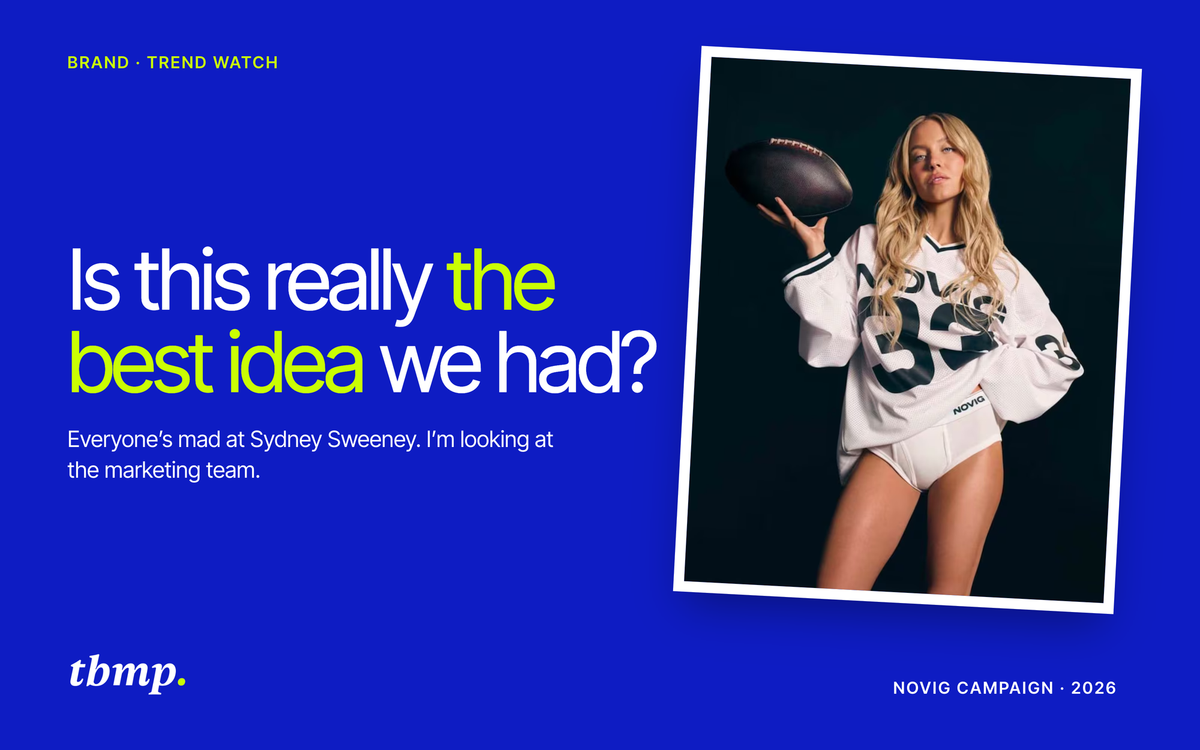
Sydney Sweeney appeared in an ad for Novig, a platform where people can trade on sports outcomes. The campaign features her wearing very little, with balls and other sports equipment strategically covering parts of her body.
The pitch is “just sports.”
You can probably see where this is going.
Female athletes started responding with footage of themselves training and competing, alongside variations of: “Dear Sydney Sweeney, this is what women in sports look like.”
Gymnastics, swimming, martial arts, strength, skill. ACTUAL YEARS OF WORK.
Gracie Kramer’s gymnastics response received more than a million likes, according to Variety. The original ad reportedly passed 22 million views in its first two days, according to EMARKETER.
So now we have an ad, a backlash, a response trend, and a whole other argument about whether anyone should be offended in the first place.
A very busy week for something supposedly about “just sports.”
As someone who does jiujitsu… really?!
Jiujitsu is a very male-dominated sport. I participate in it because I want to learn it, get better at it, and do the actual sport.
So yes, I understand the raised eyebrows.
And before someone says it: I know this wasn’t an ad for a women’s sports league. Sydney wasn’t claiming to be an Olympian. It was an ad for a sports prediction platform.
That context matters, but it also doesn’t make the creative choice immune to criticism.
They chose sports as the setting and a woman’s body as the thing to look at.
Women, who spend their lives having their bodies evaluated for everything except what they can do, were always going to have something to say about that.
What bothers me isn’t that Sydney has a body or chose to show it. It’s how familiar the idea is.
We have all these extraordinary women doing extraordinary things, and somehow the exciting advertising concept is still: what if a woman was almost naked?
OH. We’re doing that one again.
I liked seeing the response videos. I liked that women gave people something else to watch. I’m also annoyed that “please acknowledge our actual sport” apparently still needs a content strategy.
Then the marketing part of my brain showed up
Because while I understood the criticism, I could also see how the campaign benefited from being criticised.
Someone shares the ad because they hate it. Their friend asks what Novig is. Someone makes an explainer. Someone else defends Sydney. Now there are reaction videos to the reaction videos, and the original brand keeps coming up.
By then, the campaign has travelled well beyond the people who would willingly watch an ad for a sports prediction platform.
Do I know that the team planned this exact chain of events? No. I wasn’t in the meeting.
But do I think the possibility of backlash somehow escaped everyone involved in approving this campaign?
Come on.
My read is that they were willing to risk people being offended to get people paying attention. And if attention was the brief, congrats, they got plenty of it.
I refuse to clap just because I can see the strategy.
I work in marketing. I know why a brand might want a reaction strong enough to make people post. I also think we’ve become far too generous with the word “genius” when a campaign makes everyone argue.
A comment section on fire is very easy to screenshot for a presentation.
The harder questions come later.
How many people became customers?
What did it cost to get them?
Did they stick around?
Did people remember the brand, or just Sydney and the argument?
I haven’t seen results that answer those questions. Twenty-two million views is a substantial amount of attention, though.
And NO, the women responding didn’t “fall for it”
This is the part I really want to push back on.
Whenever an ad causes outrage, someone inevitably announces that the critics are giving the brand exactly what it wants.
Usually with the energy of someone who thinks they’re the first person to understand advertising.
Yes, criticism can spread a campaign. But what are women supposed to do with that information? Quietly dislike it so nobody can accuse them of helping the engagement numbers?
A brand choosing to provoke people doesn’t make those people stupid for responding.
And the responses had value beyond the original ad. Gracie’s million likes belong to Gracie. Someone watching her perform might leave interested in gymnastics. Someone watching a woman train might decide to try that sport.
Novig doesn’t get to claim ownership of every good thing women made out of a conversation it helped start.
That would be an extremely generous reading of its contribution.
Which brings me back to that imaginary marketing report.
I can believe the team got a lot of the attention it wanted. I can believe the backlash helped the ad travel. I can even acknowledge that provoking people is a commercially tempting choice.
I still think the idea was tired.
And I’d like to work in an industry where “but everyone’s talking about it” is the beginning of the discussion, because I have several follow-up questions.
Starting with: Is this really the best idea we had?