Google’s AI Content Update Has One Awkward Question for Marketers: What Did You Add?

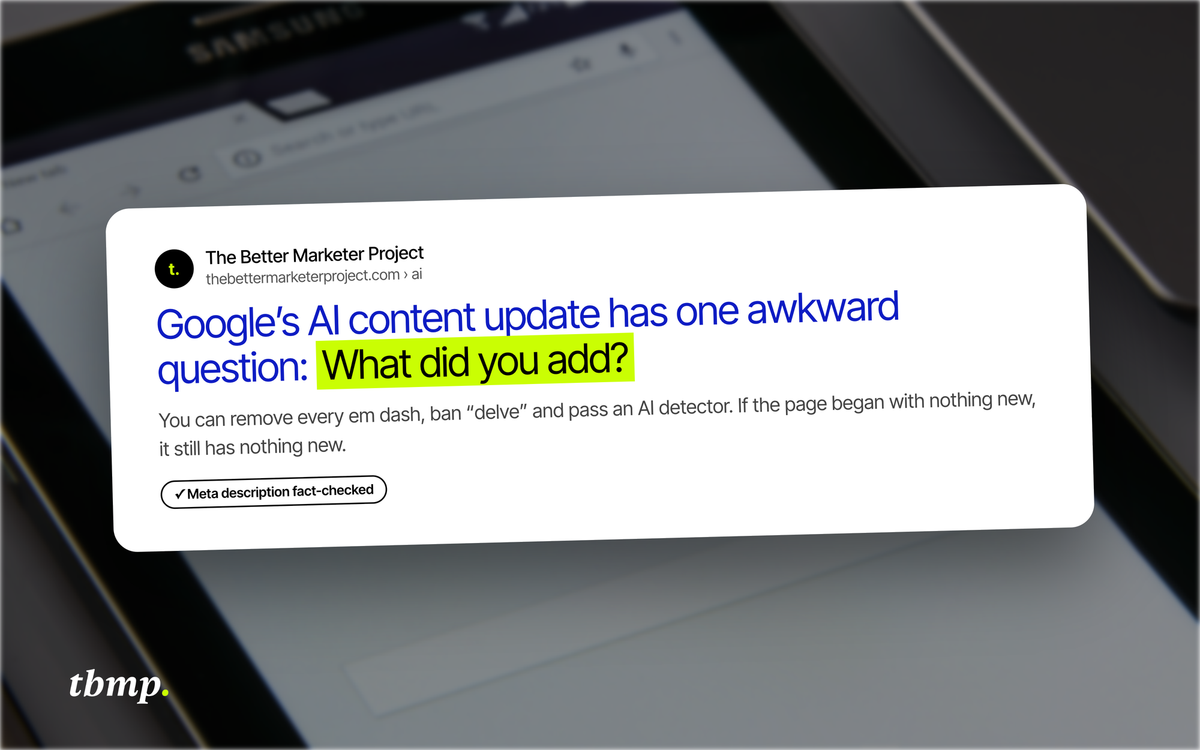
You can remove every em dash, ban “delve” and pass an AI detector. If the page began with nothing new, it still has nothing new.
Somewhere, a content team is deleting every em dash from 200 AI-generated articles because Google updated one page of its documentation.
The articles still say nothing.
But at least they look human now.
On October 1, Google updated its guidance on using generative AI content. Give the internet approximately five minutes and I’m sure we’ll get:
GOOGLE IS PENALISING AI CONTENT.
AI BLOGS ARE DEAD.
HUMAN WRITERS HAVE WON.
Except that is not what happened.
Google did not announce a new AI-content penalty. It updated its guidance to make one thing explicit: publishers should manually fact-check AI-generated content before it goes live, including the title tags, meta descriptions, structured data and image alt text attached to it. Google’s wider position did not change. AI can help with research and structure; pumping out pages with little original value can violate its spam policy.
According to Google’s own changelog, this was a documentation update. Google added information from its Search Quality Rater Guidelines so the public guide would match what it had already been presenting at developer events.
No new AI ban was announced. No detector score was introduced. Google did not say a page becomes suspicious the moment ChatGPT touches a sentence.
In fact, its updated generative AI guide says AI can be useful for researching a topic and adding structure to original content.
The word doing a lot of work there is original.
Google’s warning is about using AI to generate many pages without adding value. It also reminds publishers that generative models predict likely sequences of words rather than retrieve facts, which is why their answers can sound extremely confident while being extremely wrong.
Google now explicitly says AI-generated content needs to be manually checked for accuracy and trustworthiness before publication.
That includes the boring bits people forget about: title tags, meta descriptions, structured data and image alt text.
Yes, the meta description your AI wrote at 11:47 p.m. because everyone wanted to go home still needs checking.
This is much less dramatic than “Google hates AI.” It is also far more useful.
Does Google penalize AI-generated content? That’s still the least useful question.
Whenever Google mentions AI content, marketers immediately ask:
How much AI can we get away with?
Will Google know?
How do we make it pass a detector?
But the question worth asking is much simpler:
What did we add?
Google’s scaled content abuse policy applies to large amounts of unoriginal content that provide little value, “no matter how it’s created.”
That last part matters.
A human can type an empty article very slowly. It does not become more useful because somebody suffered through it.
An AI tool can help research, structure and improve a genuinely valuable piece of work. The tool touching the draft does not automatically erase the interviews, testing, data or thinking behind it.
The real divide is content built from something versus content built from nothing.
AI did not invent articles written primarily to occupy search results. We had “The Ultimate Guide to Everything You Already Know” long before ChatGPT arrived.
AI simply changed the economics.
One weak idea used to become one weak article. Now it can become 80 before lunch.
You cannot edit your way into originality
Most advice about making AI content sound human focuses on the sentence:
Delete the em dashes. Stop saying “delve.” Vary the sentence length. Add a personal anecdote. Use slang. Make it sound less polished.
Fine. Some of that can improve the writing. It still cannot manufacture a finding, a customer quote, a tested example or an opinion.
Imagine a SaaS company wants an article called “Five Benefits of Automated Invoice Reconciliation.”
Someone gives that title to an AI tool. The tool scans the usual information and gives them:
- Save time
- Reduce errors
- Increase efficiency
- Improve financial visibility
- Scale your operations
Is any of that necessarily false?
No.
Did the company contribute anything another accounting platform could not have published?
Also no.
Now imagine the writer starts somewhere else.
They speak to the company’s finance lead. They review onboarding calls and support tickets. They discover that customers are not simply “saving time.” Several finance teams used to spend part of Sunday closing their books, and the product helped them finish on Friday afternoon instead.
That is the article.
The AI can transcribe the interview, group recurring themes, pressure-test the outline and help turn the research into a clean structure. It can even suggest ten titles.
The four words I would put on every content brief
Google’s current people-first content guidance points to four attributes its quality raters examine in a page’s main content:
Effort. Originality. Talent or skill. Accuracy.
Google is very clear that quality-rater scores do not directly decide how an individual page ranks. Treat these as an editorial standard.
Still, they make a much better content brief than “1,500 words, include the keyword six times and make it sound human.”
Effort
Effort is not the number of hours somebody spent moving sentences around.
It is the work that gave the page something worth saying.
That might mean interviewing customers, testing the product, comparing real examples, analysing first-party data, building a calculator or asking the founder a question nobody else thought to ask.
Google even says that attribution does not replace original effort.
Citing the research is responsible. The link itself is not your contribution.
Originality
Originality does not require inventing a completely new marketing theory every Tuesday.
Sometimes it is one detail your team noticed because you are closer to the problem than everyone writing about it from the outside.
It could be:
- A recurring objection from 30 sales calls
- The result of an experiment that failed
- A product decision and the tradeoff behind it
- A customer phrase that changed your positioning
- An unpopular opinion your company can actually defend
- A specific example showing where the usual advice breaks
The internet probably does not need another definition of customer retention.
It might need to know why customers cancel your particular kind of product after week three, even when they said they loved the demo.
Talent or skill
Useful information can still be buried under terrible writing, confusing structure or a page that barely works.
Skill means presenting the material in a way that helps the reader understand and use it.
That could look like clear writing. It could also be a useful template, a working tool, a well-produced video or a diagram that explains in ten seconds what three paragraphs could not.
The goal is to make the value easy to receive.
Accuracy
Correct is the floor.
Every factual claim needs to lead back to a source you have actually opened and read. Dates need checking. Statistics need context. Quotes need to exist.
If a study surveyed 100 marketers in one country, do not turn it into “consumers everywhere have spoken.”
And please check what the source actually measured. “People said they prefer X” is not the same as “X increased sales.”
Google also warns against fake author profiles, including made-up names, credentials and AI-generated headshots used to make a page look as if an expert wrote it.
Readers can feel when nobody needed to write it
This is bigger than search rankings.
In a Gartner survey of 1,006 US consumers, 65% said brands were producing too much AI-generated marketing content. Fifty-seven percent said its prevalence had made them less trusting of brand messaging.
That is one self-reported US survey, not a universal law about every buyer on earth.
But it does point to something marketers should probably take seriously.
People do not need to run paragraph three through forensic software to know when a company had nothing to say.
They can feel it in the vague examples. The suspiciously perfect transitions. The article that promises a strong opinion and spends 900 words explaining both sides of something before concluding that “the right approach depends on your unique needs.”
Groundbreaking.
Before you publish, find the receipt
Every substantial article should contain evidence that some thinking happened before the writing.
I call that the receipt.
Before publishing, I would ask these five questions.
1. What did we see, test, hear, calculate or decide ourselves?
Point to it.
A customer conversation. A campaign result. A product demonstration. An internal debate. A repeated sales objection. An actual screenshot. A decision that produced a consequence.
If the only input was the current search results, the article will probably look like the current search results.
2. What can the reader get here that the existing sources do not already give them?
A summary can be helpful when it saves somebody time.
But if you are summarising five other articles, your contribution needs to be more than putting their paragraphs in a different order.
What did you connect? What did you question? What did you explain better? What changes when the reader sees the information together?
3. Where is our actual judgment?
Facts tell the reader what happened.
Judgment tells them what it means.
Who should care? Who should ignore it? What is being overhyped? Where might the advice fail? What would you do with the information if you were responsible for the result?
Find the sentence your company is willing to defend.
If you can delete the logo and publish the exact article on any competitor’s website, that sentence is probably missing.
4. Has somebody verified every factual claim?
Open the original study. Check the announcement. Confirm the date. Read beyond the headline.
Then check the title, meta description, schema and alt text against the final article too.
AI can help identify claims that need sources. A person still has to verify them.
5. What will the intended reader know or do differently?
“Learn more about automation” is not an outcome.
Will they change a content brief? Question a metric? Avoid a mistake? Explain an idea to their CEO? Choose between two tools? Rewrite a campaign?
If the strongest reason for publishing is “we needed something for Tuesday,” the calendar is running the strategy.
Start with the material, then open the AI tool
A serious AI-assisted content workflow should begin before anyone writes a prompt.
Collect the raw material first:
- Customer language
- Call transcripts
- Product evidence
- Original research
- Campaign results
- Internal expertise
- Source documents
- A real question worth answering
Then give AI a bounded job.
Ask it to group patterns in the notes. Compare competing explanations. Find gaps in an outline. Flag repetition. Suggest counterarguments. Produce title variations. Turn a finished article into a short social post.
AI can organise an interview.
It cannot be allowed to invent what the interviewee meant.
A person still owns the premise, interpretation, consequential claims, sources, final voice and the decision to publish at all.
That last one matters. A generative model has no discomfort about producing a paragraph whose only purpose is to fill a heading.
SEO still matters once the page deserves to exist. Clear headings, useful metadata, internal links, structured data and an understanding of search intent can help a valuable page be found and understood.
They cannot supply the valuable part.
Google’s advice is annoyingly ordinary
Check your work.
Add something.
Help the reader.
That simplicity is probably why some teams will try to turn it into a detector score, a prompt template or a 47-point “humanisation” checklist.
Please don’t.
Use AI. Bring evidence. Have a thought. Check the facts. Put a real name on the page and be willing to defend what it says.
AI can write the sentence.
It cannot take responsibility for publishing it.
That part still belongs to you.
Before your next post goes live, ask one question:
What exists on this page because we knew, tested, noticed or believed something?
If the answer is just “more words,” it is not ready.
The Better Marketer Project looks at what changed, what it actually means and what marketers should do with it. Subscribe free for new issues every Tuesday and Friday.